Showing posts with label creativity. Show all posts

Friday, 4 November 2016

Learning To Cook At 60

My mother, who’ll be 93 this month, said life began for her at 60, possibly because her youngest turned 18 that year.  Her mother passed her first driving test at 63, left the home she’d been born in and became a university dorm mother, forming relationships that lasted the rest of her life. 

The world outside my bedroom window.
Me?  On my 60th birthday, I’d been incapacitated for 5 months by an illness I secretly didn’t believe in.  My days had been reduced to watching magpies outside my window chase copulating pigeons away from the view of their own impressionable fledglings.

I used to have plans that didn’t include getting tired every time I took a shower.  At first glance, it seemed everything had been stolen from me.  Gradually, though, it became evident that I was on the same journey I’d always been – i.e. my life – the only difference being that rather than going 70 mph down the freeway, I was now on foot. 

In practical terms, that meant that a few minutes weeding the rose garden followed by a few minutes of lying on my back watching the buzzards and kites scream at each other over sky space, well, eventually that does get the job done. 

Or as a Valentine's Day craft.
One day, lying on my back took the form of plopping down on the couch beside Siobhán who was watching Mary Berry make a chicken pie on TV.  The part where they wove the pie crust reminded me of the woven heart Christmas decorations we made in Appalachia.  I can do that, I decided. 

Later, when Siobhán made her own chicken pie, she couldn’t remember how to weave the crust.  Without consulting anything or anybody who might know better than myself (which would be just about anything or anybody), I took on the job.

When the scientific mind cooks, wine is essential.
Let’s stop here for a life observation.  The scientific mind (that would be Siobhán) interests itself in rules – learning them, repeating them, sticking to them in order to repeat desired results.

The creative mind has an element of oppositional defiance in it that constantly asks, Why?  How can this be better?  Can that be more suited to my liking?  When does the fun come into this?

So when Siobhán tells me that Mary Berry says we need 2 packages of pastry for the crust & we only have one, I decide to go for it, even though I know feckall about cooking and, well, she’s Mary Berry. 

But the creative mind is more than oppositional.  It’s curious.  I wanted to know why

this 

Lora's pre-bake weave.

turned into this.  

A lake has formed.

Re-watching the episode proved the instructions were a little more complicated than my memory of them. 

I watched another episode in the series and thought, oh my . . . what I’ve missed, being surrounded by good cooks all my life.  

Making smoke.
Into the kitchen I go.  And no, I didn’t become scientific.  My mind had its questions.  I substituted what I didn’t have.  I added what I thought I’d like better.  I made a lot of smoke.  And I got to eat as well.  Several times.

The lesson my mother and grandmother passed along from their sixties wasn’t about achieving.  It was about taking a life’s worth of kickass learning and moving forward with as much bravery and foolishness as I did in my twenties, despite whatever shit life has hurled at me.  It’s about recognising that the ability to experience something, to experience anything really, well that’s just about two shades past precious.  It’s not a Pollyanna, look on the bright side, never get what you want but be grateful approach.  It’s accepting reality in its ugly and miraculous because that's what being alive is, then seeing what the fuck this next thing’s all about.  In other words, while it’s not 70 mph, keep moving and you’ll meet things.

Going it on foot.
If I hadn’t gotten sick, I’d probably find as much depth in my life as I do now because that's what creative minds do.  Most likely, though, I’d not stop weeding the roses to watch the buzzards and kites.  And I certainly wouldn’t take the time to learn to cook.  But I did, so I am.  It ain’t heroic.  Cooking’s not life changing (unless it’s fatal, which in my case, is possible.)  But I am.  I’m going to learn how to cook at 60. 


Tuesday, 10 March 2015

A Virtual Update

So you know that whole virtual learning course I was taking?   With 3 veterinarian events that require house arrest for a certain Doodle, surprising things are happening there.

First off, I’ve spent a lot of time writing in my head.  Many writers do this anyway, but early in the process, I usually need to write things down, have a tangible hard copy to work on.  Being deprived of that seems to bypass my cognitive brain. 

As a result and against my will, my antagonist staged a coup ousting my protagonist and became my main character, bringing a complexity, if not a depth, I hadn’t anticipated to a (third) catalyst character.  

The other consequence of Doodle duty is that my reading assignment is getting done in 2-3 minute intervals.  Thus, passages that I would’ve sped through –­ I’m so smart, I already know all of this – now have my extended attention. 

For instance, I’d just finished reading about outdoor vs indoor scenes when it came time to abandon all hope & cross the threshold into We Do Not Race Maniacally Thru The House Until The Stitches Come Out, i.e. a fortuitous attempt to reduce MY physical world by containing the pup.

My WIP associated with the course, Night Vigil, deals with how our childhood shapes our limitations in adulthood, as seen in the death watch of an abusive man by his wife and son.  Reading about outdoor/indoor gave me the idea of reaching past the stage into possibilities for both son & mother that wait for them after the man’s death.  There are already musical off-stage voices, but I now look for how to extend both the mother and son by being heard off stage , looking out windows, opening doors, as they try to escape where life has restricted them at the moment.

Then props.  I’d written in the father’s violin as shortcut to a lot of his history.  Obviously a prop to look at, especially one connected with a character who keeps his family in its particular status.  What more work could it do besides telling us the father is a musician?  And so the violin becomes an animate thing to the son and his sibs when they were children, and is still a way of knowing if their father were home by its presence or absence. 

Also, like many abusers, this father is charming.  In other words, Voice is a significant aspect.  The violin’s song.  The father’s song.  The choice of melody played,  in this case, one that’s initially playful but has minor tones in it, suggesting something darker even though pizzicatto.  Lastly, holding the violin, aligns any character with the father.

These are more than, Far Out, Man, devices.  Signifying the violin and being aware of the expansion or compression of space both give another tool when developing the plot.  I get stuck, I ask myself where all the characters are, where should they be, and of course, where’s the blasted violin?

As alluded to above, there were two characters whom I always wonder – are they needed?  They were in a first scene at the son’s house, one as the mother’s foil and the other as the son’s ally.  But were they needed for the rest of the play and if not, why introduce them at all? 

But a Doodle Nurse moment collided with a reading section on how silent observers could change what would be a sombre moment into a comedic one.  I’ve had this lifelong fascination with witnessing for people during anonymous but significant life events.  It made sense that the witnessing of any intense moments in a play could change the quality of those moments, and in other directions besides comedic. 

I then wrote an argument between mother and son that digresses through a momentary crumble in the mother’s cognition, but ends in a loving moment.  Quite a complicated emotional nosedive, but having it witnessed, allowed me to stop the action and give the audience time to assimilate what happened.  I did this by having the son and his ally exit, leaving the mother and her foil alone in an awkward silence, followed by an exchange between the two women that furthers understanding of the mother.

So this play that started as static  –  a mother and son changing their relationship by sitting a death watch  – gets energised via trying to keep a frenetic but recuperating puppy from being energised in my own life. 

Beyond all that I’ve learned about writing plays, I think I’ll slow down my technical reading in future, let things simmer more.  My only complaint is no 3D people to discuss this with!  

Saturday, 25 January 2014

Creativity, Privilege, Ethics

That young woman was not a happy puppy.

At a reading of my play Cats in a Pipe, a young female actor in the audience asked why the characters were all male.  While I explained my creative decisions, her expression said I was another Man With Tits.  As soon as I stopped talking, she challenged me again.  The director jumped in and supported the gender choice.  The actor let it go, but the expression on her face didn’t change. 

I don’t find fault with her.  She wants the right to creative expression in a field where each minute that passes makes her less employable.  Dehumanising, to say the least, but I don’t back down from my creative choices for that play.  This is an And-Both situation.  A female actor should develop her craft through all age brackets and a female writer should write male characters.  But the former is not the case, so if I do the latter, do I stop another creative’s work?  If I don’t do the latter, do I stop mine?

Years ago, Paul Simon made an album in South Africa during apartheid.  What’s your initial reaction to that?  Did he exploit black South Africans, steal their music, make money from them?  Or did he give black South Africans an international stage?  Should art sidestep politics?  Can it?  At the time, Simon said that if Stevie Wonder had made the album, everyone would’ve cheered.  Now what’s your reaction? 

Last month in this blog, I wrote that we should metaphorically give the Rosa Parks of today a seat on the bus.  One of my good friends privately called this into question: in terms of using privilege to help, we may deny individuals the right to perform their own personal revolution.  Which isn’t to say privilege should never intervene but that we assess that intervention.  In the real world, a Rosa Park is more in need of support and protection for her revolution, than she is of being offered a seat. 

But in the creative world, are our decisions the same?  Am I responsible for female actors having more opportunities when my creativity develops in another direction?  Should Paul Simon have bankrolled a black musician to do what he wanted to creatively explore himself?  Do we have the right to censure other creatives for their choices? 

I don’t think we have the right to censure the creative choices of others, unless they move into illegal areas.  I do think it helps everyone to discuss these choices. 

I listened to both the actor and to my friend when they disagreed with me.  I thought about their perspectives but I thought about my friend’s perspective longer.  Certainly, because there was more at stake in a friendship than in an audience Q&A, but also because the actor didn’t appear to want to have a discussion. 

Maybe that's because I didn’t let her know that I heard her point of view.  Or maybe I actually didn't hear her point of view.

Her question was, as a female playwright, should I have written an all male cast.  When I didn't answer that question, what could she do, but challenge me again?  In effect, I silenced her. 

If instead of explaining myself, I’d asked her, 'Do you think a female writer should never write a male lead?' she may have entered into discussion with me.  She may have understood my creative decisions and I may have considered ways to develop creatively AND respect her need to create as well.

I missed my chance with her but today I’m saying to you, let’s have this discussion. What do you think about how creative development and social responsibility interact?  Even if we feel we're being silenced, let's not give up.  Let's discuss.

Friday, 29 November 2013

How Does Your NaNo Grow?

The final two days of NaNoWriMo and some of us have fallen to the wayside, bloodied and muddied, pens and printers empty of ink, bodies convulsing with anathesaurus shock while febrile comrades shout out they’ve completed their goal early.  Bastards.  Me, with two days left, there’s 3260 words needed to meet my goal, which for the non-NaNo savvy, means about 300 words better that the minimum daily requirement. 

This year, rather than a novel, I decided to write a daily short story.  It’s elegant to reduce a theme to a defining moment, not to mention that a writer of long fiction needs to churn out shorter works too.  However, I tend to get caught up in my novels and neglect shorter forms.  I faced NaNoWriMo with trepidation that I couldn’t do this thirty times over.  My fear wasn’t that I couldn’t do it well, but that I couldn’t do it at all.

The oddest thing happened.  Nearly every night this month, I’ve had a vivid dream which, the next day became my Nano contribution.  If you’ve ever kept a dream journal, you’ve probably amazed yourself with the range and clarity of your imagination.  But not every November morning was a vivid dream day for me, so the Butler tossed out a topic and off I went, no problem.  The dream experience seemed to prime the creative activity in my brain, and stories came.

Silk sock yarn.
Great for me, eh?  I dream my Nano into being like some type of New Age psycho.  Well, it’s not that idiosyncratic.  You can structure this process by giving yourself a pre-sleep suggestion.  Or recognise that this is a normal way of writing.  That whole staring into space part of creating.  Going for a walk.  Playing Patience (Solitaire) until an idea or phrase works itself into being.  (Me, I knit weird socks.) 

The essential factor in all of this is to relax.  To let it happen.  To trust that you have inside that noggin of yours the ability to express.  That means stop thinking about blog hits and trending topics and punctuation.  Simply let your voice spill onto the page without censor. 

So how did I do in my Nano?  A story a day, as required, but at some point my brain connected themes from the separate stories.  Then juxtaposed characters and put them into the same world.  Dramatic arcs sprouted.  Yesterday, I caught myself filling in a pre-novel extended synopsis grid. 

As I was knitting a weird sock this month and waiting for a sentence to straighten itself out in my head, I tried to figure out how many stitches made the total sock.  I’m not great at doing mental math, so never got the answer, but I did see a correlation between the type of brain that patiently click click clicks out hundreds of thousands of stitches for something as common as a sock, and the brain that tap tap taps out hundreds of thousands of words to write a novel.  It’s the long haul type of brain.
Hairy nipple sock.

However, that brain can knit what is fondly called in my house, the hairy nipple ankle sock or stay the course and knit an over-the-knee silk stocking.  The essential process is the same.  It’s the design and the desire that makes the final decision.  

NaNo’s taught me that I can write a short story a day.  I'm not sure which direction my Nano 2013 will grow now, but if we knew in advance where we were headed, it wouldn't be fun at all.

Friday, 30 August 2013

Home from Edinburgh*

The Butler (my husband, not the movie) planned to spend August covering his colleagues’ holidays rather than take one himself.  Fine with me, as I had a novel that needed attention.  However.  I didn’t do the responsible thing when one evening he said, ‘I have a few days off.  Let’s go to the Edinburgh Book Festival.’

The process of novel writing is a strange game of what-if.
Neil Gaiman 22/08/13

We took the afternoon train that rides the east coast, one of my favourite trips.  A friend met us on Princes Street, took us to Charlotte Square which had been transformed into a secret village.  There were no passport checks, but we definitely had crossed the border into Somewhere Else.

If you ignore your inside voice, you ignore it at your peril.
                                                                        Mark Billingham 23/08/13

Once inside, there was settledness to the place.  Not the spiritual tranquillity of a religious building, not an ivory tower concept or romantic notion, but the still hum of a thousand intellects invoking the imagination. 
 
It’s the journalist's business to write about politics.  The writer must write about more important things.  What is important in life is of the world without words.  The writer translates and is above the level of politics.
                                                                        Mikhail Shishkin 23/08/13

They weren’t all well behaved intellects.  Children raced and screamed and had tantrums.  Staff had to pick up litter.  These people got drunk, one woman shouting, ‘Fuck, fuck, fuck photography,’ and sent the Festival photo team skeedaddling.  

We’re inured to violence.  Fiction gets over the issue fatigue, a sneaky bastard that comes at you from the side.
Lauren Beukes 23/08/13

A thick Scottish accent bellowed at us to get in the queue.  Book signings ran like conveyor belts watched over by security.  Inside all of that, though, something felt different.

I imagine Ian Rankin walks around Edinburgh to find a car park to stuff a body.  Kind of like the Easter Bunny.
Margaret Atwood 24/08/13

Our second day there, everyone abandoned me for their sessions.  I grabbed an ice cream and a deck chair, sat down with my manuscript.  Next to me gathered a multi-generational family.  A set of middle-aged grandparents, several thirty-something parents. 

Sometimes people are undone by success.
Stephen Grosz 24/08/13

The grandfather carried a baby, talked to it, explained what the rest of the family were doing.  Nothing significant about this bunch until the other children returned. 

The true inspiration for the writer is the bank manager.
Andrew Grieg 24/08/13

Kids young enough to speed across the square with their picture books were greeted like lionesses who’d returned with food for the pride.  Adults squatted to hear the stories even if the child went through the book backwards. 

I love challenge.  At least I say that to myself before it’s started.  Halfway through, I say, this is the most terrible challenge!
                                    Antonia Fraser 25/08/13

And when the excitement calmed down, ice cream for everyone.  My kind of family, I can tell you.  They know what it takes to raise a kid.  Ice cream and books.

I feel this is an audience full of women laughing and men, not.
Naomi Alderman 25/08/13

El Punko later tweeted, Can we live here?  That’s how I felt, as though I’d found the lost tribe of my native people.  Nothing tangibly different on the outside, but on the inside – if we could do DNA tests on the soul, you’d find something a bit peculiar.

If you want a virtual reality experience that takes you out of reality, read a novel.
                                    Valerie Martin 25/08/13

Between sessions, we sat in deck chairs and read or wrote.  Some of us fell asleep.  We ran into old friends, met new ones, shared writing opportunities, lusted over book after book after book.  Bought way too many.  Ate some of the best cake I’ve ever had.

Zombies are not good on skates.
                                    Margaret Atwood 25/08/13

Sometimes I felt overwhelmed by the intelligence on the panel, both writers and moderators.  Sometimes I felt I’d underachieved.  Sometimes I felt enthused about my craft, couldn’t wait to get back to the deck chair and write write write.  After some ice cream, of course.

Burke and Hare had their good side.
                                    Ian Rankin 26/08/13

At one of Margaret Atwood’s sessions, a man asked her what to do with all the stories in your head, if you weren’t a writer.  She said something close to: Anybody who can write things down is a writer.  Then it’s up to you to become a better writer.  (Take that, all you people who belittle writers who aren’t yet Margaret Atwood.)  

My feeling about her is she’s the perfect corporate wife.  (Lady MacBeth) 
                                    Margaret Atwood 26/08/13

Which is who El Punko wants to be when he grows up.  At first I was surprised he didn’t want to be Neil Gaiman, but then I realised Neil Gaiman hasn’t grown up yet, which is really quite lovely.  I think becoming Margaret Atwood is an admirable goal, even without the writing bit.

A book can be as many books as it can be.
                                    Valerie Martin 26/08/13

My experience of the festival, though obviously limited, was that it lacked the usual hierarchy.  This is a craft and everyone there loved it; some of us in the creation but all of us in the appreciation of it.  So while there was a yurt where the writers could hide, they also sat with their families in deck chairs, stood in line for talks, bought ice cream from the stand without being mobbed. 

Adults have no attention span.  They give up and go away long before you’re finished.  (Having stories read to you.)
                                    Neil Gaiman 26/08/13

That ethos, perhaps, of egalitarianism, reinforced in me the need for writers (and all creatives) to support each other in an honest but positive fashion.  That includes supporting yourself as well, despite people who don’t believe you have something to say.  If Ian Rankin and Mary Talbot and Val MacDermid don’t mind walking among the rest of us, then feck the begrudgers and walk here as well.

We were just talking about Jane Austen’s underwear.
                                    Margaret Atwood 24/08/13


*All writer quotes are as close to what was said as possible.

Friday, 16 August 2013

The Seriousness of Magic

Mount Grace
This weekend, the Butler and I went to an open air production of Sense and Sensibility set on the grounds of Mount Grace Priory, a National Heritage site.  Mount Grace itself can be seen across the fields on some of Big Nose Dog’s walks; the names of two houses in our village boast of a priory view, now obliterated by mature trees.  

Places like Mount Grace call on us to create magic, I think.  If you’re not sure what I mean, could you walk through these grounds and not imagine what went on there?  That’s our innate ability to be in our minds where our bodies are not.  That has to be magic, does it not?

Butler & Sis in front of chapel
The site’s history that I know, starts with a fourteenth century Carthusian charterhouse that survived only a little over 140 years of religious contemplation.  Then Henry VIII sent Mount Grace on its travels through various owners to the Lowthian-Bell family who gave us Gertrude Bell. 

There’s a woman whose life makes the jaw drop.  Up in the manor's attic, you can see where someone recorded the children’s heights, look at old family photos and listen to staff talk about Gertrude; you won’t be thinking about monks and a fat old profligate wanting a son, although all those things happened here.

Magic.  Imagine putting on open air theatre in such a place.

The Hamper
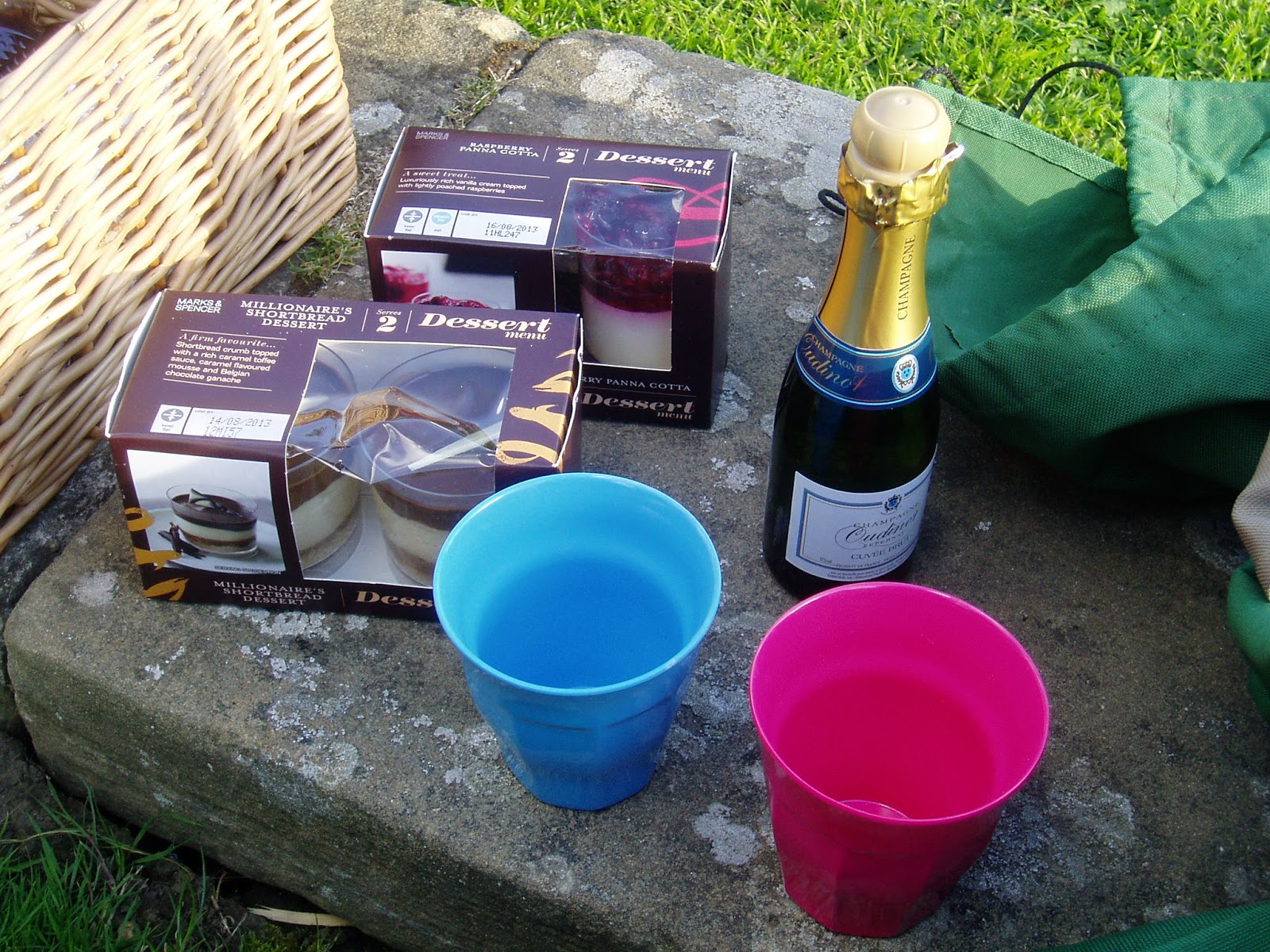
The Butler packed a picnic for the masses, although there were only we two.  We stowed canvas chairs and hamper and rug into Little Car, had to park in the overflow area, so many people had come, and a few of those on foot.  We claimed a space on a little rise at the back, across from the old Carthusian guest house.

The audience included people from the Point to Point set who brought fold-away tables covered with fabric cloths, dressed in their Dubarry boots and wool jackets and stockman riding coats, although the group to our right put an eighteenth century spin on the dress code.  Here were the considered-successful of the community, some, like the Butler, with serious day jobs, yet the desire for fun, for magic, it sizzled through the audience with childhood intensity

The group next to us
Neil Gaiman writes in his latest book that none of us are adults, rather children inside adult bodies.  Those of us who openly admit our need to create, to imagine and pretend well into adulthood, we’re the ones who put on the period dress, pack two desserts inside the hamper (well, four, if you count the Betty's cakes and how could you not), drink champagne from children's cups.

Humans ache for opportunities to create, whether it’s decorating the house, writing a play, sitting at a National Heritage site to watch an open air performance that helps us imagine another life in another time.  It’s a fine line, though, for those of us who are driven to create.  More is asked of us, perhaps unfairly so.

Because we have the temerity to put our creations on show, we cannot purely create with the abandon of children, nor even stop at thinking about grammar and structure, the indelible dramatic arc.  More important than bringing forth the myths inside us, we’re told the world now wants us to count Twitter followers, blog hits, Likes and RTs.  It’s the high school game of popularity taken to a fiscal level.  Be in, rather than be creative.

For some of you, the two are the same.  For me, it’s hard work.  There’s many a good intentioned person who’s crossed my path to utter several Don’ts about what I write or how I write or even that I write.  

I thank whatever deity who hangs around me, that none of those naysayers actually live in my house, because it becomes harder and harder as I read a blog about self publishing or how to utilise social media, for me to keep the fun in what I’m doing.  If those horrid little voices lived inside the Writing Closet, I’d probably set fire to the  thing and start taking copious doses of Valium.

I don’t want my myths or voice to be critiqued into someone else’s idea of what I  should say. 

The open air performance itself could be hailed as good-enough theatre, an assessment that might disappoint some to hear.  But for me, it was a great success because it was great fun.  Nature graced us with a soft rain during the second half, as well as a serious owl fight somewhere on the hillside; bats kept flitting close to the stage and nary an eighteenth century lady flinched. 

When the play ended, we gathered up our things by torchlight, I stopped between the manor and the chapel just to look, and it impacted me viscerally, what it would've been like to step out the back door at night as a child and see the Priory’s ruins. 

‘How magical it must’ve been,’ I told the Butler.

And it’s that magic that I struggle to hold onto.

Friday, 14 June 2013

Let the Dark In

Last week in the Writing Closet, we listened.  This week, we speak, but not of ordinary things.  This week we speak of our darkness.

What Happened.
Something’s happened.  Something you don’t understand.  You’re not the type of person it should happen to or you’re not the type of person who would do something like that.  It doesn’t make sense. 

People say things like, what were you thinking?  What did you do to make that happen?  Surely it’s not as bad as you say.  Why do you have to be so negative?  Why are you always such a drama queen?  They look at their watch when you speak.  They say that you’re weak.  On and on until you learn to stop speaking about it.  You pretend it didn’t happen and everyone’s happy.

It doesn’t have to be physically violent, although it could be.  It doesn’t have to be monumental, even, except to you.  What is your What Happened?  Can you say it out loud, to yourself, when no one’s in the room, no one’s outside the door?  Can you whisper, This Happened, and still feel yourself safe?

Touched cheated lied hit cut stole betrayed fired punched spied vandalised withdrew slandered provoked seduced abandoned changed you.

If you don’t feel safe, then perhaps today is not the day for you to continuing reading this.  Mark the page.  Come back when you’re ready.  Before you go, let me remind you, although you already know it, that we all have these things in our lives.  All of us.  There is a conspiracy not to speak of these things, yet these are the things a writer must speak.  But before she does, she must feel safe.  Only when you’re safe, should you write.

Not What You Are
One of the ways to help you feel safer is to separate the act from the person.  You are not what you did.  You are not what was done to you.  You may be a person who cheats on her partner but also loves that partner to distraction.  Who you are could explain the Why, but what you do, does not define the Who.  You may be a person being stalked by an ex-lover and you also help the parents of autistic children.  What happens to you is your history, not your talent.  You are more human and more normal than these experiences, held in secret, let you believe.

If you can speak about what happened and still feel safe, you will write it.  This is a given.  The trick is how you write it.  We’ve been taught to follow that sacred dramatic arc, come hell or high water, to reach a resolution.  Popular entertainment teaches us that this resolution should eclipse the What Happened.  Now I’m going to contradict myself.

Rather than eclipse it, think about embracing it.  Okay, didn’t I just write that you need to separate yourself from the What Happened?  Yes.  And if you separate yourself successfully, you won’t have to obliterate it.  You can change it into literature.  The dark, like the right side of your brain or your animus or your psychological shadow is bursting with energy that you can tap into it.  But how?

Play with What Happened
When the EDL went to protest outside a mosque in York, they were invited inside for tea and football.  This is what you have to do.  Invite What Happened in for a cuppa.  Sit with it a while, get to know each other.  And when you are safe, play.  And by play, I mean ground yourself physically in What Happened.  Let your body feel the experience while at the same time, maintaining your own integrity as separate from What Happened, just as you would do when immersing yourself in a character you’re developing.  When you do, it will give things to you.  Some of these things may give you insomnia, but you will learn to use them.

My current manuscript keeps me up at night.  Not because of structure and form, not because of plot and characterisation but because of the question, Is it ever right to kill someone?  Euthanasia.  Abortion.  Death penalty.  War.  Murder.  Is it ever right . . . This story is a blatant sublimation of What Happened in my own life.  Well, blatant to me.  There’s not a lot of killing going on in my life, but the creation of that question did come from What Happened.   And believe me, it’s a lot more interesting than What Happened, because it takes the themes of the personal events and puts them on a universal stage.

Which actually is the basis of most therapeutic approaches to trauma.  Research shows that regardless of the treatment modality, the most important factor to a traumatised person is reconnection to the broader community.  The sooner that happens, the better her chance of recovery. 

We are, after all, social creatures.  What Happened in your life belongs to the society of US.  Get yourself safe.  Invite What Happened in for tea and football.  Embrace it.  Share it.  Say it out loud.

Eva Ensler
For inspiration, read this interview with Eva Ensler. 


Friday, 7 June 2013

Shh, listen . . .

I have a friend who cannot listen.  She’s not deaf; she’s wired in such a way that she cannot listen to someone else’s part of the conversation.  Not that she’s dismissive.  She’s a charming, intelligent, energetic person whose brain flits through synapses like a mouse tossed in the air by a cat.

If I use the phrase, ‘rabbiting on,’ she grabs the conversation out of my mouth by saying, ‘Speaking of rabbits,’ and then proceeds to tell me about how her cousin’s neighbour’s son, Todd whose name means ‘fox’ and that somehow relates to rabbits which is connected to what I was saying by . . . I really don’t know how. 

Three minutes into any conversation and she renders me invisible, even though I can be quite entertaining on occasion.  When she gets a topic between her teeth, there’s no stopping her.  She came to dinner once, homemade dessert in hand and while we were scarfing it down, dissected its failings.  Initially we tried to disagree but she was unstoppable.  As she trashed her contribution, a silent black pall fell over the group.  And then the Butler filled everyone’s glass and we drank deeply.

I’m a former professional listener and ten minutes with her exhausts me.  If you cannot listen, your environment will stop trying to access you.  Which is isolating.  Which builds up the stuff in you that you want to say.  Which makes listening harder, perhaps nearly impossible.

Imagine that.  If you couldn’t listen, imagine how much of your environment you wouldn’t take in.  Imagine how much of your environment would withdraw from you.  Imagine.  As a writer, if you can’t listen, what happens?  It certainly reduces your perspective to one – yours.  So how do you write characters if the only perspective rattling around in your brain is your own?

Well, most of us are made up of parts, but after a while, writing these parts will produce a certain sameness.  And if the only perspective inside your head is the inside of your head, then the only resolution of plot lines will be a reverberation of the same old same old.  Writers, artists, actors cannot grow if we do not perceive the otherness of the world.  Our art comes from the flint spark of what is us, crashing into what is not us. 

But there is another type of listening.  Listening to that old right brain of yours.  Remember, the left side of the brain is the language brain.  It goes forth into the world and because it is language, it tells us it’s the only ME you have.  But it always takes along the right side of the brain, the symbolic brain, the intuitive brain, the creative brain.  The right brain is a communicator, too, but it speaks to us in non-linguistic ways.  We have dreams, urges, intuitions, premonitions, creeped out shivers, anxious moments, inclinations. 

The UK based script writers in the crowd have had a flurry of contest deadlines these last two months.  For most of my writing life, I’ve done long prose, but the last three or four years, I’ve done script as well.  It’s a writing form that insists upon perceiving beyond oneself during the creation.  Scripts require other people in order to come into artistic being; that aspect makes it deliciously addictive.
 
Please notice me.
As I was driving myself toward these script deadlines, an unfinished prose piece kept intruding into my work.  I would put it off by promising to get to it when these essential, life-preserving deadlines were met, but the damned prose thing was like the Big Nose Dog when he needs to go for a walk – his chin on my knee, those deadly brown eyes boring into my usually impervious conscience.

My right brain was speaking to me and I wasn’t listening.  As a result, writing became an obligation.  I wasn’t having fun and we know how important fun is to a writer.  I sent a script to Papatango and Bruntwood, then pulled out my piece for the Verity Bargate.  I typed.  I deleted.  I took Big Nose for a walk.  I savaged weeds in the garden.  I sat in the hammock, stared into space.  I typed.  I deleted.  My play for the Verity Bargate was going nowhere.

Then I closed the script document.  Opened the prose document.  And wrote.  Hours and hours of highly energised writing which only stopped when the Butler came into my office and announced it was time to eat.  I’d listened to my right brain and I was having fun again.

Spend this week listening.  Listen to the racists who are pissed off over the Cheerio ad.  Listen to the endless commentary on Prince Philip’s private medical situation.  Listen to birds, the sound of motors and wind and the latch on the gate.  Listen to obnoxious children whining that it’s not fair and drunkards who know the meaning of life.  Listen to your mother’s advice, even though she’s given it to you 7032 times already and she’s really, really wrong about that.  Listen to your friend who never listens to you when she talks about Todd.


And when all that listening is done, listen to old right brain.  Or watch for it.  Or let it touch your muscles and skin.  Listen and you’ll know.  You will, I promise you.

Friday, 24 May 2013

Keep the T-Bird

Twice this week, I’ve read that we physically need creativity, play and rest.  Considering that last week, I posited the mental health issues of writers, this is good news.  The caveat here is that when we downgrade writing from creativity and play into work, it’s like what happens after Daddy took the T-Bird away.

A few months ago, Amanda Palmer used her TED talk to urge the arts community to give their work back to the people, asking for only what we need.  Then Palmer paid her local front bands with hugs and beer, which drew comparisons between the financially successful musician and the record labels she meant to combat. 

What Palmer suggests does appeal on an emotional level, but practically speaking, someone has to pay for our beans on toast.  In response to Palmer’s TED Talk, Cord Jefferson writes that the voice of American journalism now comes from the ‘trust fund babies’, as entry level jobs in the field have dried up in favour of unpaid internships.  To build a writing portfolio, the budding journalist must have financial back-up to allow her to give her words away.  Not only does this practice silence voices from lower economic brackets, usually voices of colour, but it devalues the work of writing.

http://gawker.com/5989280/when-people-write-for-free-who-pays

This dilemma isn’t the sole prize of writers.  The entire crop of fledgling artists face the choice of putting all their eggs in the arts basket or having a day job while trying to enter the arts work force through an after-hours doorway.  A young friend of mine who chose the former path, still lives with his parents, puts all his energy into breaking into his field, and says he has no social life outside of contacts in the arts community.  While we can admire his dedication, this time of his life isn’t balanced; it forces him to make decisions about his life that his age peers in other professions don’t have to make, and pressures him to succeed or give up his chosen career. 

Doesn’t sound much like creativity, play and rest.  More like grappling for survival.  While the general consensus outside the creative community is that artists should live a life of deprivation in order to create, I say, bullshit.  There are things we can do to lobby for more support of the arts, a long but needed process.  In the meantime, let’s also take care of ourselves. 

Creative people are great for thinking outside the box.  Ellen Langer in her book, On Becoming An Artist, suggests we remember to ‘pursue art for life’s sake’.  As a writer, you know the feeling of your senses opening up in order to transform external stimulus into art.  Creativity makes us more aware of our life, which improves its quality, but also lets us see possibilities and solutions that a non-creative approach doesn't illuminate.  The trick is to step outside the box, but not lose sight of the practicalities involved.  In other words, pay the front bands more than hugs.

Brené Brown writes in The Gifts of Imperfection that we should make a list of things that we think will improve our lives, then reduce from that list the number of ‘accomplishments and acquisitions’, replace them with things that provide ‘joy and meaning’.  Once we’ve adjusted the list, it’s important that we also implement the list.  In other words, do we really need to submit work to forty-five magazines in the space of six weeks or would we have better mental health and practice greater creativity if we only wrote one kickass piece in that time? 


 Okay, so one piece doesn’t pay the bills.  I don’t suggest that we eliminate the accomplishment and acquisitions list.  We subdue it slightly.  We change our focus from what we do, to what we experience and feel.  From what job we hold, what awards we win, what publications we’ve broken into, to who we are as people, what voice we cultivate as writers, what stories we tell, what messages we relate, how well we create, play and rest.  It is the creative person’s equivalent to an athlete’s fitness regime.

Research from the National Institute for Play in California shows that play shapes our brains in a way that promotes empathy, helps us understand complex social interactions, underlies creativity and innovation in the arts, science, maths and more.  

http://www.nifplay.org/contactus.html
What that means is play makes us higher functioning human beings who can understand the internal life of others better, move successfully through difficult social situations, think outside the box AND communicate this information in an artistic way that can be understood and assimilated by other people.  Creativity, play and rest could actually be the salvation not just of writers, but of the race.  

Go forth and ply your trade.  Write, submit, worry about deadlines, build your writing history.  But play.  Be silly.  Laugh.  Crack silly jokes.  Dress in costume.  Sing in the grocery store.  Hang on to your T-Bird.  Have fun, fun, fun while eating your beans and toast.